Nervous System Regulation for Anxiety: 10 Techniques (2026)
Table of Contents
Quick Answer
Bottom line: This profile helps you evaluate wellness providers fast with essential decision data.
Key Facts
- Verification status: editorially reviewed
- Data refresh cycle: ongoing
- Best for: users comparing options quickly
Disclosure: This article contains affiliate links. If you book through them, we may earn a commission at no extra cost to you. Our recommendations are based on evidence and reader fit, not commission rates.
Nervous System Regulation for Anxiety: 10 Techniques (2026)
Chronic anxiety is often not merely a thinking problem. It is fundamentally a body problem. Your nervous system may have learned to treat ordinary situations as threats, and no amount of logical reassurance changes that pattern on its own. What does change it is working directly with the physiological state driving the anxiety, through a set of evidence-informed practices known as nervous system regulation techniques.
This guide covers 10 of the most researched approaches, explains the science behind each one, and helps you choose the entry point that fits your current state. Whether you are dealing with acute panic or chronic stress, understanding how to reset your autonomic balance is crucial for long-term wellness.
What Is Nervous System Dysregulation?

Nervous system dysregulation means your autonomic system gets stuck in fight-or-flight or freeze, producing chronic anxiety, fatigue, and emotional overwhelm. The autonomic nervous system (ANS) has two main branches: the sympathetic (mobilization, stress response) and the parasympathetic (rest, digestion, recovery). In healthy regulation, these branches shift fluidly based on actual context.
When dysregulation sets in, the sympathetic branch stays activated even when no real threat exists. You feel on edge, scan for danger, struggle to sleep, and find it hard to connect with others. According to Stephen Porges’ Polyvagal Theory, there is also a third circuit: the ventral vagal complex, which governs social connection and the felt sense of safety. Regulation techniques target all three circuits to restore balance.
Common Symptoms of Nervous System Dysregulation
- Persistent anxiety or hypervigilance even in safe environments
- Fatigue that does not improve with rest
- Digestive complaints (irritable bowel, nausea, bloating)
- Difficulty concentrating or making decisions
- Social withdrawal or emotional numbness
- Chronic muscle tension, jaw clenching, shallow breathing
If several of these are present for more than a few weeks, working with a practitioner alongside self-practice tends to produce faster results.
Why Regulation Techniques Work: The Science
The body communicates upward to the brain through the vagus nerve, the longest cranial nerve, which runs from the brainstem to the gut. An estimated 80% of vagal fibers are afferent: they carry information from body to brain, not the other way around (Klarity Health Library).
This means physical interventions (breath, movement, touch, vocalization) change brain state directly, often faster than cognitive reframing. Somatic exercises in particular have been shown to strengthen alpha rhythms (7 to 14 Hz) in the somatosensory cortex, which acts as a sensory filter and reduces hypervigilance.
Polyvagal-informed research also demonstrates that co-regulation (using the presence of another safe person to regulate your own nervous system) is one of the most potent tools available, which is why therapeutic relationships, not just techniques, produce lasting change.
10 Nervous System Regulation Techniques for Anxiety

Each technique below targets a different entry point into the autonomic nervous system. Choose based on your current state and available time.
1. Diaphragmatic Breathing With Extended Exhale
Best for: Acute anxiety, panic onset, pre-sleep wind-down.
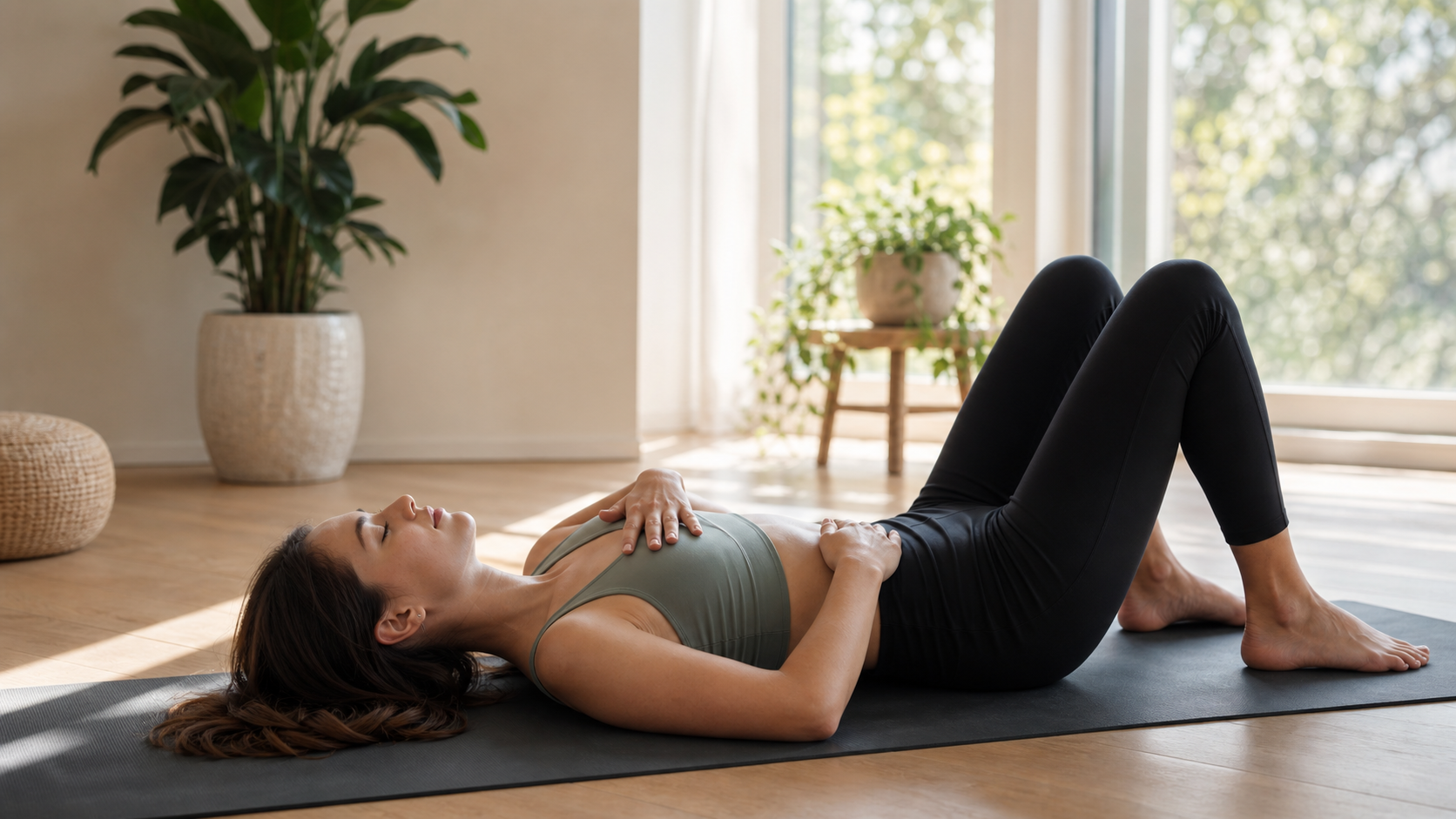
The most direct route to vagal activation is a slow, deep exhale. When you extend your exhale longer than your inhale, heart rate variability (HRV) increases and the parasympathetic branch activates. Research cited by Apollo Neuro confirms this is among the fastest-acting self-regulation tools.
Protocol: Inhale through the nose for 4 counts. Exhale slowly through pursed lips for 6 to 8 counts. Repeat for 5 minutes. Practice twice daily, not only during acute stress, to train baseline vagal tone over time.
2. Physiological Sigh
Best for: Rapid reset during a stressful moment, midday anxiety spike.
A physiological sigh is a double inhale followed by a long exhale. It deflates collapsed alveoli in the lungs and rapidly shifts carbon dioxide/oxygen balance. A 2023 Stanford study published in Cell Reports Medicine (Balban et al.) found it outperformed mindfulness meditation for immediate stress reduction. It takes under 30 seconds and can be done in any setting.
Protocol: Take a normal inhale, then sniff in a short second inhale through the nose. Follow with a long, slow exhale through the mouth. Repeat 1 to 3 times.
3. Slow Environmental Scanning (Orienting Response)
Best for: Hypervigilance, feeling unsafe in familiar environments.
Polyvagal theory identifies the orienting response as a key tool for signaling safety to the brainstem. When you turn your head slowly and let your eyes move without a fixed target, you activate the ventral vagal complex and down-regulate the defensive response. Kate Bartlett Psychology describes this as one of the most accessible daily practices for anxiety.
Protocol: Sit or stand in a safe space. Slowly rotate your head from left to right. Let your gaze drift without focusing. Notice colors, textures, and light. Do this for 1 to 2 minutes, ideally when entering a new environment.
4. Bilateral Rhythmic Movement
Best for: Sympathetic discharge, restlessness, post-stressful event.
When the nervous system mobilizes for fight-or-flight, it releases cortisol and adrenaline. Walking, running, swimming, or any bilateral rhythmic movement discharges this mobilization energy and promotes neurochemical recovery through serotonin and BDNF release. This is distinct from “exercise for mood”: the mechanism is specifically autonomic discharge, not just endorphins.
Protocol: 20 to 30 minutes of brisk bilateral movement (walking, swimming, cycling). Bilateral = both sides of the body in alternating rhythm. Even 10 minutes after a stressful event can reduce the residual activation.
5. Vagal Humming and Vocalization
Best for: Freeze states, dissociation, difficulty accessing feelings.
The vagus nerve runs through the larynx and throat. Humming, singing, or gargling creates vibration that directly stimulates the vagal trunk, activating the parasympathetic response. Dr. Arielle Schwartz notes that vocalization is particularly effective for people who struggle to feel the effects of breath-only practices.
Protocol: Hum on a single tone for 5 to 10 minutes. Or gargle with water for 30 seconds, rest, and repeat 3 times. Chanting, singing, or reading aloud also activate the same pathway.
6. Cold Water Exposure (Brief and Gentle)
Best for: Acute anxiety spike, emotional flooding, dissociation.
Splashing cold water on the face
Related reading: Best 7 Nervous System Regulation Techniques to Fix Anxiety Fast
FAQ
Why trust this information?
Profiles follow a quality checklist and are updated when new verified data is available.
How do I request corrections?
Use the contact page to submit updates with supporting details.
Get the Wellness Finder Pro digest
Honest reviews and no-hype guides — straight to your inbox. No spam, unsubscribe anytime.
Some links in our articles are affiliate links. See our full Affiliate Disclosure for details.