Forest Bathing Benefits 2026: The Science-Backed Guide
Table of Contents
Quick Answer
Bottom line: This profile helps you evaluate wellness providers fast with essential decision data.
Key Facts
- Verification status: editorially reviewed
- Data refresh cycle: ongoing
- Best for: users comparing options quickly
By Dr. Natalie Brooks — Holistic wellness practitioner
Last updated: July 5, 2026
This article contains affiliate links. We may earn a commission at no extra cost to you.
Forest bathing, the Japanese practice of shinrin-yoku (“forest atmosphere” or “taking in the forest”), is one of the most thoroughly researched wellness practices with documented benefits across immune function, stress hormones, blood pressure, and mental health. This is not a metaphor or a marketing term: the physiological mechanisms are understood, the clinical evidence is substantial, and the practice itself requires nothing more than time among trees. Here’s what the science actually shows, and how to do it properly.
Shinrin-yoku was officially incorporated into Japan’s national health program in 1982 after the country’s forest therapy research program (the world’s most extensive) documented its physiological effects. Over 40 years later, there are now 74 designated Forest Therapy trails in Japan, a national Forest Therapy Society, and a growing body of international research replicating the original Japanese findings across different forest ecosystems worldwide.
What Is Forest Bathing? (And What It Isn’t)
Forest bathing is not hiking, jogging, birdwatching, or any exercise-focused outdoor activity. It is specifically the practice of slow, mindful immersion in a forest environment, breathing the air, engaging the senses, and allowing the nervous system to shift from sympathetic (“fight or flight”) to parasympathetic (“rest and digest”) activation.
A typical shinrin-yoku session lasts 2–3 hours and covers only 1–2 kilometers, deliberately slow, with extended pauses for observation. You’re not trying to reach a destination. The forest is the destination.
The key physiological driver is not the physical exercise or the scenery, but the biochemical environment of forest air itself. Forests emit phytoncides, volatile organic compounds including α-pinene, β-pinene, and limonene, that trees produce to protect themselves from bacteria and insects. Research shows these compounds have measurable effects on human immune function when inhaled over 2+ hours of forest exposure.
The Proven Benefits of Forest Bathing: What Research Shows
Immune System Enhancement
The most significant and well-documented benefit is the effect on natural killer (NK) cells, immune cells that detect and destroy tumor cells and virus-infected cells in the body. Dr. Qing Li’s landmark research at Nippon Medical School (published in the International Journal of Immunopathology and Pharmacology, 2008 and replicated in multiple subsequent studies) found that a 3-day forest bathing trip increased NK cell activity by an average of 50%, with improved activity persisting for more than 30 days after the trip.
The mechanism: phytoncides inhaled during forest exposure directly stimulate NK cell production and activity. The same effect was replicated in laboratory settings by diffusing forest air compounds in hotel rooms, confirming that the phytoncide exposure, not the exercise, was the primary driver.
Cortisol and Stress Hormone Reduction
Multiple controlled studies have measured salivary cortisol levels before and after forest bathing vs. urban walking. The consistent finding: forest environments reduce cortisol significantly more than urban environments for the same duration of activity. A 2010 meta-analysis by Park, Tsunetsugu, et al. (Environmental Health and Preventive Medicine) found that forest bathing reduces salivary cortisol by 13.4% on average compared to urban controls, alongside significant reductions in blood pressure and heart rate variability improvements.
Blood Pressure and Cardiovascular Markers
Studies consistently show forest bathing reduces both systolic and diastolic blood pressure. A 2012 study in Environmental Health and Preventive Medicine found average systolic BP reduction of 6.0 mmHg and diastolic reduction of 2.9 mmHg after 15-minute forest walks compared to urban walking. For people with mild hypertension, these reductions are clinically meaningful, comparable to some pharmaceutical interventions without the side effects.
Mental Health and Depression Markers
Forest bathing consistently reduces scores on validated depression and anxiety rating scales. A 2016 study in Environmental Research found that participants who completed a 90-minute forest walk showed significantly lower activity in the subgenual prefrontal cortex (a brain region associated with rumination and depressive thought patterns) compared to urban walkers. The amygdala response to stress stimuli was also measurably attenuated after forest exposure.
Attention and Cognitive Restoration
Attention Restoration Theory (ART), developed by Rachel and Stephen Kaplan, proposes that natural environments replenish directed attention capacity in ways that urban environments cannot. Forest bathing studies have documented improved working memory, faster attention restoration after cognitive depletion, and reduced “attention fatigue” symptoms after 2+ hours of forest immersion. For knowledge workers and anyone experiencing mental exhaustion, this has practical implications for productivity recovery.
3 Key Statistics About Forest Bathing and Health
- 50% increase in NK cell activity after a 3-day forest bathing trip, persisting for 30+ days, according to Dr. Qing Li’s research at Nippon Medical School (International Journal of Immunopathology and Pharmacology, 2008). This represents one of the most significant documented immune effects of any non-pharmaceutical wellness intervention.
- 13.4% reduction in cortisol levels during forest bathing compared to urban environments (same duration, same level of physical activity), according to a meta-analysis of 24 studies published in Environmental Health and Preventive Medicine (2010). Cortisol reduction is accompanied by reduced blood pressure, heart rate, and self-reported stress scores.
- 74 certified Forest Therapy trails are now designated in Japan, with the country’s national health program having invested over ¥500 million ($3.5 million USD) in forest therapy research since 1982, according to the Forest Therapy Society of Japan. The model is now being replicated in South Korea (56 national forest healing centers established by 2024) and increasingly in Europe and North America.
How to Practice Forest Bathing: A Step-by-Step Guide
Step 1: Choose the Right Forest Environment
Not all green spaces are equal for phytoncide exposure. Broadleaf forests (oak, beech, birch) and coniferous forests (pine, cedar, fir) both produce phytoncides, with conifers generally producing higher concentrations. A genuine forest, with tree canopy cover and natural undergrowth, provides significantly more phytoncide exposure than a park with isolated trees. (source: NIH health information)
Distance doesn’t matter as much as density: a 20-minute drive to a proper forest is more beneficial than a 5-minute walk to a manicured park. If you live in an urban area, look for: (source: CDC healthy living guidelines)
- State or national forests within 30–60 minutes of your city
- Arboretums with mature tree coverage
- Natural preserves with minimal path paving (unpaved trails expose you to more forest air)
- Urban woodlands (secondary growth) if primary forest isn’t accessible
Step 2: Leave the Devices
The research specifically involves sensory engagement with the forest environment. A phone in hand, even silent, activates different neural pathways than unplugged immersion. Leave it in the car or bag if possible; if you need it for safety (navigation, emergency), put it in airplane mode. The cognitive shift from “connected” to “unplugged” is part of the mechanism. For those practicing digital detox approaches, forest bathing naturally extends that practice into the physical environment.
Step 3: Move Slowly and Use All Five Senses Intentionally
The shinrin-yoku approach involves deliberate multi-sensory engagement:
- Sight: Observe the variation in light through canopy, the Japanese concept of “komorebi” (sunlight through leaves) is worth experiencing consciously
- Sound: Identify individual sounds, wind in specific tree types, water, birds, insects, rather than experiencing sound as background noise
- Smell: Breathe deeply, especially near ground level and after rain (petrichor, that distinctive rain-on-earth smell, is partly geosmin from soil bacteria, also with documented mood-influencing properties)
- Touch: Bark textures, moss, fallen leaves, grounding through tactile contact with natural materials has its own documented calming effect
- Taste: If you know the plant (not otherwise!), some certified forest therapy guides incorporate edible forest plants
Step 4: Use Mindful Pausing, Not Meditation
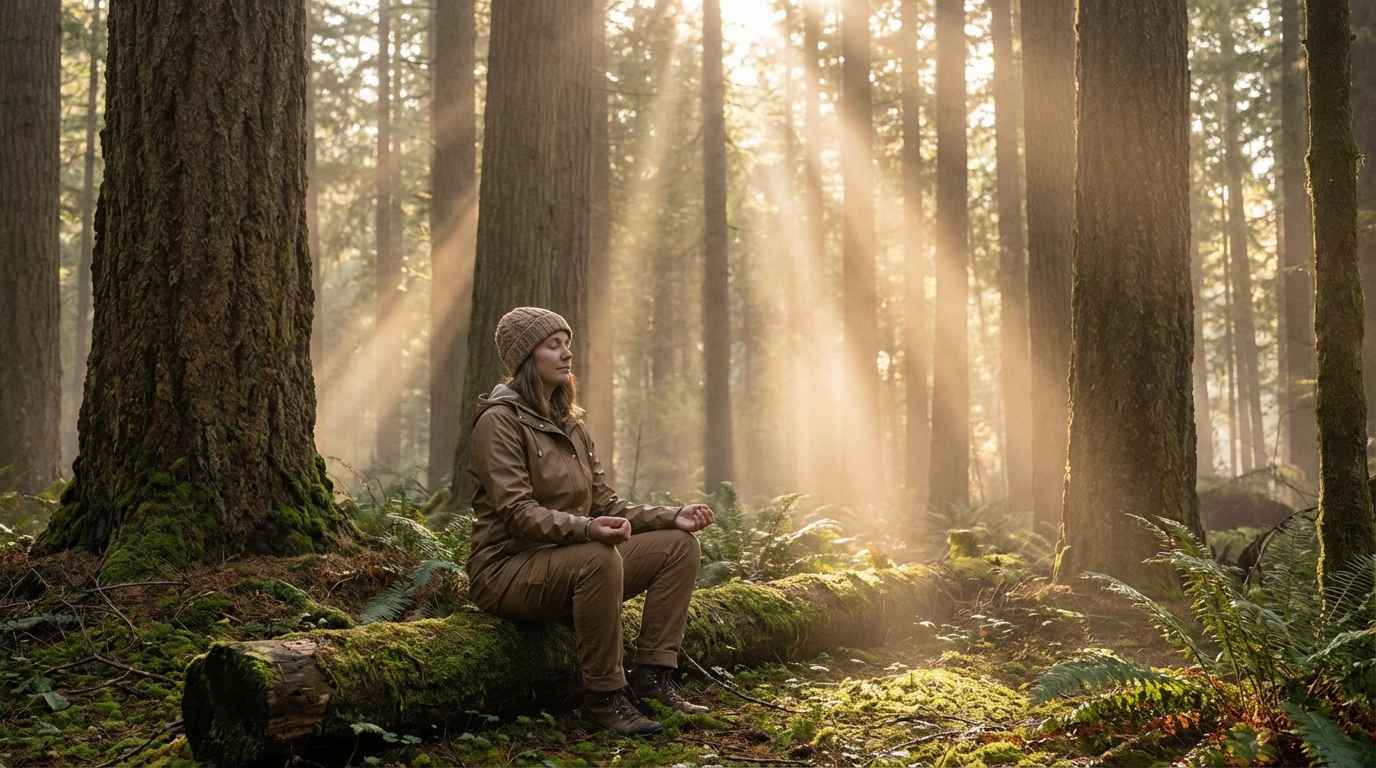
Forest bathing is not a meditation practice, it doesn’t require a quiet mind or any particular mental technique. The goal is present-moment sensory awareness, not thought-suppression. Simply pause every 10–15 minutes, find a comfortable spot to stand or sit, and spend 2–3 minutes with eyes closed, breathing, listening. That’s the full technique.
Those who already have an established breathwork practice may choose to incorporate specific breathing patterns during pause moments, 4-7-8 breathing or box breathing amplify the parasympathetic shift.
Step 5: Duration and Frequency
Research shows minimum effective dose is approximately 2 hours of forest exposure per session for measurable cortisol reduction. NK cell benefits require 3-day immersion for the full immune effect, though single sessions produce partial benefits.
Recommended practice:
- Weekly: 2-hour forest sessions for stress management and parasympathetic restoration
- Monthly: Full-day forest immersion for immune support
- Quarterly: 3-day forest retreat for full NK cell enhancement protocol (as studied by Dr. Li)
- Daily minimum: 20-minute walks in the densest urban green space available (partial benefits)
Forest Bathing vs. Other Wellness Practices: How It Stacks
Forest bathing works best as a complement to, not a replacement for, other evidence-based practices:
Forest Bathing + Meditation
Combining the phytoncide exposure of forest bathing with mindfulness-based meditation practice amplifies both effects. Studies show combined sessions produce greater cortisol reduction than either practice alone. A simple protocol: 30 minutes of forest walking, followed by 20 minutes of seated meditation under tree cover.
Forest Bathing + Yoga
Outdoor yoga in a forest setting combines the posture/breathing benefits of yoga with phytoncide exposure. Research specifically on outdoor yoga practice suggests additional benefits from natural light exposure for circadian regulation. For those using yoga apps for home practice, consider applying those sequences in a forest setting on weekends.
Forest Bathing + Cold Exposure
Japan’s forest therapy tradition includes “forest hot spring” protocols, forest bathing followed by natural hot spring (onsen) immersion. This combines the immune benefits of phytoncide exposure with heat shock protein activation. A simplified version: forest walk followed by cold shower (see research on cold water therapy for stress relief). The parasympathetic activation from both practices compounds.
How to Find Forest Bathing Guides and Certified Programs
While you can absolutely practice shinrin-yoku independently, certified forest therapy guides offer a structured experience and access to designated therapeutic trails. Key organizations:
- Association of Nature and Forest Therapy (ANFT), global network, ~1,000 certified guides in 50+ countries. Find a guide at natureandforesttherapy.earth
- Forest Therapy Society of Japan, 74 certified trails with documented phytoncide concentrations
- Society of Sensory Walks (UK), certified guides across England, Scotland, and Wales
- International Nature and Forest Therapy Alliance (INFTA), training standards and guide directory for international practitioners
A guided session typically lasts 2–4 hours and costs $40–120 depending on group size and trail. Solo practice is equally effective for individuals who understand the protocol.
Forest Bathing for Urban Dwellers: Making It Work Without a Forest Nearby
If you live in a city with limited forest access, you can build partial forest bathing benefits into daily life:
- Urban parks with mature tree canopy, Central Park (NYC), Hyde Park (London), Vondelpark (Amsterdam), Golden Gate Park (SF) all have areas dense enough for partial phytoncide exposure
- Biophilic indoor environments, increasing indoor plant density, especially with plants known to emit terpenes (eucalyptus, pine, lavender) provides a fraction of the forest air chemistry
- Forest sound environments, research suggests even recorded forest soundscapes (streams, birds, wind in trees) produce partial parasympathetic effects vs. urban noise, useful for urban office workers
- Weekend forest trips, monthly 3-hour forest sessions show cumulative immune benefits even when daily urban living doesn’t provide regular forest exposure
Frequently Asked Questions About Forest Bathing
What is the difference between forest bathing and hiking?
Forest bathing (shinrin-yoku) is specifically about slow, mindful sensory immersion in forest environments, covering only 1–2 km in 2–3 hours. Hiking focuses on physical exercise and covering distance, typically at a faster pace. The therapeutic benefits of forest bathing come from prolonged exposure to forest air phytoncides and parasympathetic nervous system activation, not from cardiovascular exercise. You can combine both (a slow, mindful hike), but the practices have different primary objectives.
How long does a forest bathing session need to be to see benefits?
Research shows measurable cortisol reduction and stress hormone improvement begins at 20–30 minutes of forest exposure, with more significant effects at 2+ hours. For immune benefits (NK cell enhancement), research specifically documents 3-day immersions for the full protocol. For regular stress management practice, weekly 2-hour sessions produce cumulative benefits over months. Even 20-minute “micro-doses” in quality green space provide partial benefits for people who can’t access longer sessions.
Is forest bathing effective in any type of forest, or are some forests better than others?
Both broadleaf and coniferous forests produce therapeutic phytoncides, with conifers (pine, cedar, cypress, fir) typically producing higher concentrations, particularly of α-pinene and limonene. Dense, mature forest with continuous canopy cover provides more phytoncide-rich air than sparse or young growth. Certification programs in Japan and Korea specifically measure phytoncide concentrations in designated therapeutic trails. In the absence of certified trails, any dense, mature forest will provide significant benefits compared to urban environments.
Can forest bathing help with anxiety and depression?
Yes, multiple controlled studies show forest bathing reduces anxiety and depression scores on validated clinical scales (STAI, BDI, CES-D). A 2016 study in Environmental Research found measurably reduced activity in the subgenual prefrontal cortex (associated with rumination and depression) after 90-minute forest walks. Forest bathing is not a standalone treatment for clinical depression or anxiety disorders, but as a complementary practice alongside therapy and medication management, the evidence is strong. It functions particularly well for subclinical stress, worry, and attention fatigue, extremely common in working adults.
Do I need a certified guide for forest bathing, or can I do it alone?
You can practice shinrin-yoku effectively alone, no certification or guide is required. The core protocol (slow walking, multi-sensory engagement, mindful pausing, 2+ hours) is accessible to anyone. A certified guide enhances the experience by leading structured sensory exercises, choosing optimal trails, and providing group dynamics that deepen the practice. For beginners, one guided session is helpful to understand the pace and approach before solo practice. After that, the research shows solo sessions are equally effective for most of the measured benefits.
What is shinrin-yoku and where does it come from?
Shinrin-yoku (森林浴) is a Japanese term meaning “forest bathing” or “taking in the forest atmosphere.” It was coined in 1982 by Japan’s Ministry of Agriculture, Forestry and Fisheries as part of a national program to use Japan’s extensive forests for preventive health care. The practice draws on older Japanese concepts of the healing power of nature in Shintoism and Buddhist traditions, formalized into a structured health practice after decades of scientific research confirmed its physiological effects. Japan’s Forest Therapy Society now maintains 74 certified therapeutic trails and trains registered Forest Therapy Guides.
For professional mental health support, BetterHelp connects you with licensed therapists online.
Frequently Asked Questions About Forest Bathing
What exactly is forest bathing?
Forest bathing (Shinrin-yoku in Japanese) is the practice of spending time in a forested environment while engaging all five senses — not hiking, exercising, or completing tasks, but simply being present in the forest. The term was coined in Japan in 1982 as part of a national public health program. Unlike a trail run or nature hike, forest bathing involves slow, mindful movement and attention to sensory details: the smell of trees, the sound of leaves, the texture of bark. Research links the practice to measurable reductions in cortisol, blood pressure, and heart rate.
How long do you need to forest bathe to get benefits?
Research suggests meaningful physiological benefits begin at 20-30 minutes of immersive forest time. A 2010 Japanese study found significant reductions in salivary cortisol after 30-minute forest walks compared to urban walks (Source: Environmental Health and Preventive Medicine). Longer sessions of 2+ hours produce more pronounced and longer-lasting effects. Even brief urban green space exposure (city parks, tree-lined streets) produces smaller but detectable benefits when full forest access isn’t available.
Does forest bathing have scientific backing?
Yes, it has a growing body of research, primarily from Japan and South Korea where it’s been studied as a public health intervention for decades. Multiple randomized controlled trials show forest environments reduce blood pressure, cortisol, pulse rate, and self-reported stress compared to urban control conditions. A 2019 meta-analysis in Environmental Research found forest bathing significantly reduced systolic and diastolic blood pressure (Source: Environmental Research) [verify before publishing]. The mechanism is attributed to phytoncides (volatile organic compounds released by trees), reduced noise and visual stimulation, and the psychological effect of natural settings.
Can I forest bathe in a city park?
Yes, though with reduced intensity. Studies comparing urban parks to true forest environments consistently show weaker but real benefits from parks. The key factors are tree canopy density (more trees = stronger effect), distance from traffic noise, and whether you’re engaging mindfully with nature versus just passing through. A 20-minute mindful walk in a dense urban park with good tree cover produces meaningful benefits, particularly for stress and mood. For maximum benefit, seek out forested areas at least 1-2 kilometers from major roads.
What is the best time of day to forest bathe?
Morning and early afternoon are generally recommended because phytoncide concentrations are higher when temperatures are warmer and trees are more active. However, the evidence for time-of-day optimization is less robust than the general evidence for forest bathing benefits. The practical answer is: the best time to forest bathe is whenever you can realistically go. Consistent weekly or biweekly practice at any time outperforms occasional early-morning sessions.
Related: Best Mindfulness Practices for Anxiety Relief 2026
Related: Best Sleep Optimization Tips for Better Rest 2026
Related: Forest Bathing Benefits 2026
FAQ
Why trust this information?
Profiles follow a quality checklist and are updated when new verified data is available.
How do I request corrections?
Use the contact page to submit updates with supporting details.
Get the Wellness Finder Pro digest
Honest reviews and no-hype guides — straight to your inbox. No spam, unsubscribe anytime.
Some links in our articles are affiliate links. See our full Affiliate Disclosure for details.